
I Miss Video Stores — And Physical Media Is Still the Only Thing That Doesn't Disappear
Last updated: August 25, 2026
This post contains affiliate links. If you buy through them, we may earn a commission at no extra cost to you.
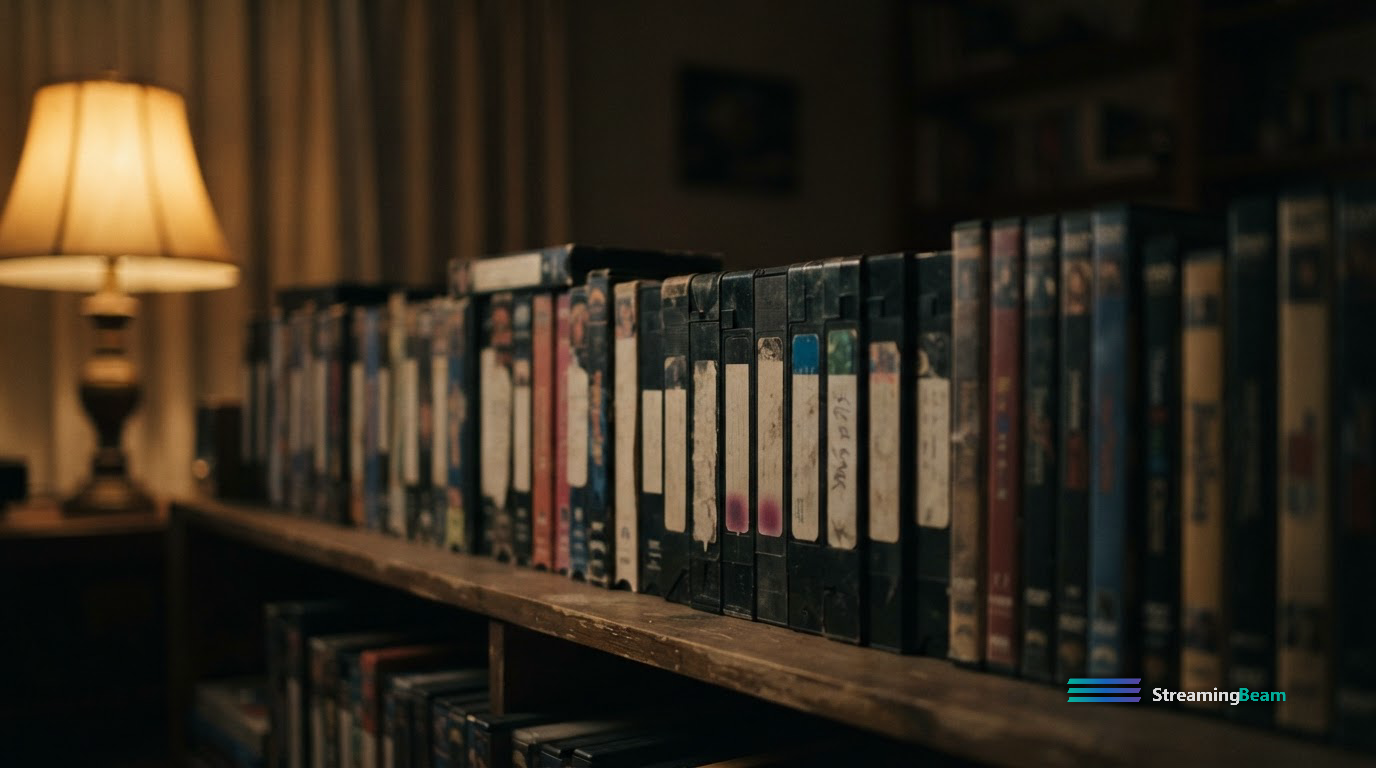
The case had weight. Not heavy — but enough that you felt you were carrying something real, a plastic clamshell with a folded paper insert, the spine slightly scuffed from the last person who'd had it. You'd read the back under the store's fluorescent light while the line moved, scanning the tiny stills and the cast list and the one quote the distributor had paid for, deciding whether the bet you'd already made still held. By the register there were candy bars racked at a height meant for children and a popcorn warmer that smelled the same in every store, and you'd stand there holding the thing you'd chosen, waiting your turn, and then you'd walk out into the parking lot with it tucked under your arm — yours for the next three days, no matter what.
That's not nostalgia talking. It's a description of a system that had one feature streaming doesn't: certainty. When you walked out with a tape, that tape was going to play when you got home. Nobody could reach into your bag and revoke it. I built StreamingBeam because finding something to watch used to be simple — you walked the aisles, you took a chance, you went home — and now it isn't. The aisles moved online, and the rules changed with them.
What We Actually Lost
When you rented a tape, that tape existed. The store either had it or it didn't, and if it did, you had it for the night. Nothing vanished mid-watch. The catalog was physical, which meant it was honest: what you saw on the shelf was what was available, and if a title wasn't there, you knew it wasn't there.
Streaming replaced that inventory with a licensing arrangement. The catalog you see is not a catalog — it's a list of titles a service currently has the right to show you, for a window of time, in a region. That window closes. The result is that the library is temporary by design, and the thing you watched last month can be gone this month without warning.
This isn't a failure of streaming so much as a feature of it. Licensing is how a service can offer tens of thousands of titles without owning any of them. The trade was always going to be certainty for scale, and streaming is better in most of the ways people measure — more choice, no late fees, no driving. I'm not arguing against any of that. I am arguing that most people underestimated how much the certainty would matter once it was gone.
Why Titles Disappear
A title leaves a streaming service for a handful of predictable reasons. The licensing window expires and the rights revert to the studio. The studio pulls its catalog onto its own platform, so a film that lived on three services now lives on one. A competitor outbids for exclusive rights. Or a title falls into rights limbo — nobody is sure who can authorize it, so nobody does, and it sits unavailable while lawyers sort it out.
We wrote a fuller explanation of each of these, with real examples of films that have no subscription home right now, in Movies You Can't Stream Anywhere. The short version is that disappearance is normal, not exceptional. It's the system working the way it was built to work.
The Case for Physical Media in 2026
A disc cannot be removed from your shelf by a licensing change. That sounds obvious, but it's the entire argument. When you own a Blu-ray or a 4K UHD disc, the film is there whether the service renews it or not, whether the studio pulls it, whether it ever streams again.
Physical releases also carry things streaming usually doesn't. Commentary tracks, deleted scenes, making-of featurettes, alternate cuts, and the kind of essays that used to come folded into the case. A lot of that material never makes it to a streaming service, because streaming optimizes for the title, not for the context around it. And on 4K UHD, the picture and sound are generally better than what a compressed stream delivers — less banding in dark scenes, no bitrate drops when the action gets busy, audio that hasn't been squeezed to fit a pipe.
The tradeoffs are real, and I'm not going to pretend they aren't. Discs cost more per title than a subscription. They take shelf space. You need a player, which is a one-time purchase most people haven't made. And physical only makes sense for films you'll actually return to — buying a disc you watch once is a worse deal than renting it digitally for five dollars. The convenience math also shifts over time: a subscription you keep for one film costs more every month you hold it, while a disc is paid once and watched for years. This isn't an argument that everyone should build a collection. It's an argument that for the films that matter to you, owning a copy is the one option that can't be taken back.
What's Worth Owning
The practical question is which films are worth owning outright. Not everything earns shelf space — most films are watched once and forgotten, and for those a digital rental is the better deal. But a few categories make more sense as something you keep.
Films with no streaming home at all — the ones that fell into rights limbo or never got picked up. If the only way to watch something is to track down a disc, owning the disc is the whole answer.
Titles that rotate off services repeatedly. Some films cycle — on a service for six months, off for a year, back on a different service. If you rewatch something every year and it keeps disappearing, the disc saves you the chase.
Movies you return to annually. The holiday film, the comfort watch, the one you put on when you're sick. You'll watch it more times than the disc costs to justify.
Releases where the bonus features are substantial. Some boutique labels build editions worth owning for the extras alone. If the commentary or the essays matter to you, the streaming cut is the lesser version.
Restorations and director's cuts that streaming doesn't carry. Some films only exist in their proper form on disc — the longer cut the service never licensed, or a restored transfer that fixes what the stream compressed away. If the version matters, the disc is where it lives.
One note: out-of-print discs can become expensive, sometimes fast. If something matters to you and the print run is gone, waiting has a cost. The price only goes one direction.
Where to Find Physical Copies
The options are straightforward. Major retailers still stock new releases, though the shelf space for physical media has shrunk a lot. For a wider catalog of Blu-ray and DVD, GRUV's Blu-ray and DVD catalog carries a broad selection of new and catalog titles, often at a discount to the streaming purchase price.
Secondhand markets — used record stores, estate sales, the online resale sites — are where a lot of the out-of-print catalog lives now. Prices vary, but the selection is often better than what's in print.
And then there's the option most people forget: the public library. Most library systems lend DVDs and Blu-rays for free, including recent releases and a surprising amount of catalog. Interlibrary loan extends that further. It's the most underused resource in media, and it costs nothing.
How StreamingBeam Fits
StreamingBeam exists to answer one question: where can I watch this? Most of the time the answer is a service you already have. Sometimes the honest answer is that it isn't streaming anywhere right now. The search covers every major service, and the Leaving Soon alerts catch titles before they rotate off, so you can watch them while you still can. That's the part of the problem software can solve. The part it can't solve is permanence — and that's the part discs are for.
Never miss what's leaving
A weekly rundown of what’s arriving and disappearing across your streaming services.
I still have a shelf of discs. I don't watch all of them often, but the ones I do, I watch without wondering whether they'll still be there next month. Some things are worth owning outright — not because streaming failed, but because some films earn a permanent spot, and permanence is the one thing a license can't give you. If you want to find what's streaming before it leaves, StreamingBeam can help: streamingbeam.com.
Want access to more streaming content? A VPN can unlock additional regional libraries. Try NordVPN →
Sponsored
Enjoying StreamingBeam? Support us for free by shopping on Amazon — it costs you nothing extra.
Affiliate link
Find What to Watch Tonight
Search every streaming service instantly — Netflix, Hulu, Max, Disney+, and more.
Try StreamingBeam Free →